Fintech company names should sound secure, modern, and easy to say out loud. The best ones combine a short, memorable word (often four to eight letters) with a subtle nod to money, speed, or trust — think Stripe, Chime, or Plaid. Avoid generic finance words like “capital” or “bank” unless you’re building a traditional institution, since digital-first customers respond better to names that feel human and approachable.

Table of Contents
- The New Rules of Naming a Financial Brand in 2026
- How to Choose a Fintech Name That Sounds Secure and Modern
- 150+ Ready-to-Use Fintech & Finance Company Name Ideas
- Real-World Case Studies: Metaphor vs. Literal Naming in Finance
- Why .ai and .io Domains Are Taking Over FinTech
- Crucial Legal Checkpoints Before Naming Your Finance Business
- Conclusion: Ready to Launch Your Financial Future?
- Key Takeaways
- FAQs
Introduction
Picking fintech company names is harder than it looks — you’re not just naming a business, you’re asking strangers to trust you with their money. A weak name makes even a great product feel risky, while a strong one signals banking brand identity before a customer reads a single feature. In this guide, we’ll walk through the psychology behind naming a financial startup, share 150+ ready-to-use ideas across neobanking, crypto, and wealth-tech, and cover the domain and legal steps that keep your brand safe from day one.
The New Rules of Naming a Financial Brand in 2026

Finance naming used to mean picking a Latin word, adding “Capital” or “Trust,” and calling it done. That playbook is fading fast. Today’s customers — especially Gen Z and millennial users signing up for their first digital bank — want financial brand names that feel less like a bank and more like an app they already trust.
Three shifts are driving this. First, digital banking infrastructure has made it possible for a two-person team to launch a neobank in weeks, so speed and simplicity in branding matter more than legacy weight. Second, regulators and consumers alike now expect visible fraud prevention and security compliance, so names that sound overly playful or vague can actually hurt credibility. Third, user engagement and trust signals now come from the whole experience — app design, onboarding, tone of voice — not just a logo, so the name has to work across every touchpoint.
Here’s what’s changed in practice:
| Old Approach (Pre-2020) | New Approach (2026) |
| Latin/Greek roots (Vantage, Meridian) | Short, invented words (Chime, Plaid) |
| Heavy use of “Bank,” “Capital,” “Trust” | Abstract or metaphorical words |
| .com only | .ai, .io, .money, .finance gaining traction |
| Formal, distant tone | Approachable, conversational tone |
| One-size-fits-all naming | Naming tailored to niche (crypto, B2B, wealth) |
The takeaway: your name still needs to earn trust, but it earns that trust differently than it did a decade ago. It needs to feel current without feeling like a fad.
How to Choose a Fintech Name That Sound Secure and Modern
Before you jump into the list below, it helps to have a filter. A good naming a financial startup process usually runs through these checkpoints:
- Say it out loud. If it’s hard to pronounce on a customer support call, it’s hard to trust. Finance names should sound clean and confident.
- Test it against your niche. A crypto exchange can afford to sound edgier than a robo-advisor aimed at retirees. Match tone to audience.
- Check for “bank-washing.” Regulators in some states restrict non-bank companies from using words like “bank” or “credit union” in their name. Confirm this early.
- Think about brand positioning for startups. Are you the affordable, no-fee alternative? The premium, white-glove option? Your name should hint at that positioning.
- Run a domain and trademark check together. A name you love but can’t legally use, or can’t get a matching domain for, wastes time. Do both checks before falling in love with an idea.
- Consider how it looks as an app icon. Most fintech customers will meet your brand on a phone screen first. Short names render better as icons and push notifications.
If you want a faster starting point before manually brainstorming, a business name generator can help you test dozens of variations quickly, then you narrow down using the checklist above.
150+ Ready-to-Use Fintech & Finance Company Name Ideas
Below, we’ve grouped ideas by the type of financial brand you’re building. Use these as a starting point — swap a syllable, combine two words, or adjust the spelling to make it uniquely yours.
1. Modern Neobanking & Digital Wallet Names (Sleek & Fast)
These names lean into speed and simplicity, ideal for digital banking infrastructure products and everyday spending apps.
| Zippay | Flowbank | Nudge |
| Tapwise | Corebank | Quickpocket |
| Swiftly Pay | Glide Financial | Pinch |
| Wavepay | Fleet Bank | Dashvault |
| Nimble Money | Sprintly | Basewallet |
| Flux Bank | Tempo Pay | Ridgebank |
| Loopbank | Nowpay | Coastwallet |
| Bristle Finance | Snapbank | Motionpay |
2. AI-Powered Wealth & Robo-Advisory Names (Smart & Futuristic)
Perfect for products built around robo-advisory and AI wealth management, where the name should feel intelligent without sounding cold.
| Wealthmind | Advyza | Coreinvest AI |
| Prospera AI | Sagewealth | Nuvest |
| Clairfolio | Brightledger | Insightra |
| Fintel Wealth | Gainwise | Predictfolio |
| Vantra AI | Wealthloop | Cognitrade |
| Alphamind | Growthly AI | Fundwise |
| Trueyield | Northstar Wealth | Elevatewealth |
| Askora Finance | Wealthframe | Signalwealth |
3. Trustworthy Crypto & Blockchain Finance Names (Secure Infrastructure)
Built for exchanges, wallets, and platforms tied to open banking APIs and decentralized finance, where security has to come through in the name itself.
| Chainvault | Ledgergate | Trustblock |
| Nodefolio | Bastionchain | Cryptobridge |
| Vaultledger | Solidblock | Ironchain |
| Keepchain | Truvault | Blocksure |
| Anchorchain | Fortiblock | Meshledger |
| Cipherfolio | Guardblock | Coinbastion |
| Lockchain | Verityblock | Shieldnode |
| Trustledger | Coreblock | Safechain |
4. B2B Fintech & Corporate Spend Automation Names (Professional & Sharp)
Aimed at platforms handling corporate spend automation, invoicing, and B2B payments, where names lean crisp and businesslike rather than playful.
| Ledgerflow | Spendcore | Payrail |
| Corevoice Finance | Fundrail | Expenseloop |
| Billtrack | Spendwise Pro | Invoiceflow |
| Corplyne | Ratioledger | Cashrail |
| Fundstack | Payloop Business | Netcore Finance |
| Spendbridge | Ledgerworks | Billrail |
| Expensecore | Fundframe | Payflow Corp |
| Costledger | Rail Finance | Ledgerbridge |
5. Short, Catchy One-Word Fintech Names (Stripe & Plaid Style)
The catchy fintech names category — short, invented, and brandable, built the way Stripe, Chime, and Plaid were.
| Fluro | Vexa | Brisk |
| Nuvo | Ledgr | Coya |
| Zenta | Plyo | Trove |
| Mova | Quilo | Vantr |
| Faro | Nudgy | Coro |
| Brizo | Palto | Sila |
| Kindl | Vaulto | Rypl |
| Fenda | Loopr | Aivo |
6. Traditional & Premium Wealth Management Names (Heritage & Trust)
For advisory firms and private wealth practices that want to signal legacy, stability, and human relationships over app-speed convenience.
| Ashcroft Wealth | Winterbourne Capital | Graystone Advisors |
| Kensworth Financial | Amberleigh Wealth | Fairhaven Capital |
| Sterling Bridge Advisors | Camden Wealth Partners | Thornbury Financial |
| Blackwell Capital Group | Rosemont Advisors | Harborview Wealth |
| Ellison & Vane Capital | Whitmore Financial | Ashford Trust Advisors |
| Brackenridge Wealth | Corbett Capital Partners | Millbrook Financial Group |
| Aldridge Wealth Advisors | Hensley Capital | Fairbanks Trust Partners |
| Wrenfield Financial | Cavendish Wealth Group | Stonebridge Capital Advisors |
Real-World Case Studies: Metaphor vs. Literal Naming in Finance
Two naming philosophies dominate fintech, and looking at real companies shows why each one works.
Metaphor-driven naming: Stripe didn’t describe what it does — a “stripe” is just a clean, simple visual, echoing the product’s promise of frictionless payments. Chime evokes a pleasant notification sound, tying into the app’s focus on gentle nudges around savings. Plaid is a fabric pattern, chosen because it sounds friendly and approachable rather than technical, even though the product connects bank accounts via open banking APIs.
Literal or descriptive naming: Robinhood took a different route, using a literal cultural reference — taking from the wealthy (trading fees) and giving to the “common” investor — which instantly communicated brand positioning for startups targeting first-time traders. Similarly, older institutions like Fidelity or Prudential chose words that directly mean trustworthiness and reliability.
The lesson: metaphor works well when you want to feel modern, human, and slightly abstract, which suits younger digital-first audiences. Literal names work better when your value proposition itself is the differentiator, and you want zero ambiguity about what you offer. Choose based on your finance company name ideas goals — are you selling a feeling, or a function?
Why .ai and .io Domains Are Taking Over FinTech (And When to Stick to .com)
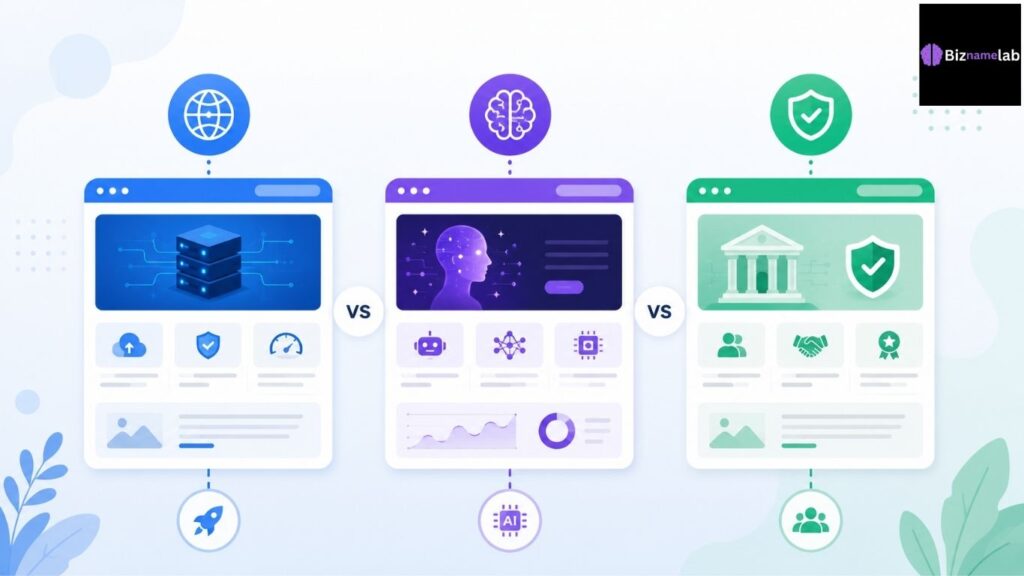
A decade ago, a fintech startup without a .com domain looked unfinished. That’s shifted. Investors and early adopters now recognize .ai and .io as signals of a modern, tech-forward company, especially in venture capital and investment firms circles where these extensions are common shorthand for “we build software.”
Here’s when each makes sense:
- Choose .ai if your core value proposition leans on machine learning or automated decision-making — think robo-advisors or fraud-detection platforms. It signals the tech is central, not an afterthought.
- Choose .io if you’re B2B, developer-facing, or built around payment gateway integration and APIs. It’s become the default for platform and infrastructure companies.
- Stick to .com if you’re consumer-facing and want the broadest possible trust signal, especially for older or more risk-averse customers who still associate .com with legitimacy. Traditional wealth management and insurance brands should lean this way.
- Grab both when possible. Many fintechs buy the .io or .ai for branding buzz but redirect it to a .com for the actual product, covering both audiences.
One practical note: domain names for finance businesses get squatted on quickly because the industry moves fast. Check availability the same day you shortlist a name, not after you’ve committed to it.
Crucial Legal Checkpoints Before Naming Your Finance Business

Financial branding carries more legal weight than most industries because regulators actively police misleading names. Before you finalize anything, run through these checks:
- State banking regulations. Many U.S. states restrict use of words like “bank,” “credit union,” “trust,” or “insurance” unless you’re a licensed institution. Confirm with your state’s department of financial regulation before printing anything.
- Trademark search. Run a full search through the USPTO trademark database before you commit. A name that’s available as a domain can still infringe on an existing trademark, which is expensive to fix after launch.
- FDIC and NCUA rules. If you’re a neobank partnering with a chartered bank behind the scenes, your marketing name must clearly avoid implying you’re a bank yourself, since trademark checks for company names alone won’t catch regulatory naming restrictions.
- State business registration. Confirm your LLC or corporation name is available in your state of incorporation, separate from any trademark check.
- Compliance review for tone. Legal and compliance teams increasingly review brand names for language that could be seen as overpromising returns or safety, which matters especially for investment and crypto products.
Skipping these steps is one of the most common — and costly — mistakes first-time fintech founders make.
Conclusion: Ready to Launch Your Financial Future?
A great fintech name does two jobs at once: it makes your product memorable, and it makes strangers comfortable handing over their financial trust. Whether you land on something short and invented like the ideas in our one-word list, or something more traditional for a wealth advisory brand, the process is the same — brainstorm wide, filter by your niche and audience, then lock it in with a proper trademark and domain check.
If you’re still exploring adjacent categories, take a look at our guides on tech and AI company name ideas and software company name ideas for more inspiration before you finalize your brand.
Key Takeaways
- Fintech company names work best when they’re short, easy to say, and hint at speed, trust, or intelligence rather than spelling everything out.
- Match your naming style to your niche — neobanks favor speed-driven words, wealth management favors heritage and stability.
- .ai and .io domains are increasingly accepted in fintech branding, but consumer-facing brands often still benefit from a .com.
- Always run a trademark check and confirm state banking-word restrictions before finalizing your name.
- Metaphor-based names (Stripe, Chime) build a feeling; literal names (Robinhood) build instant clarity — pick based on your positioning.
FAQs
1. What are the top 10 fintech companies?
Leading fintech companies as of recent rankings typically include Stripe, PayPal, Block (formerly Square), Chime, Robinhood, Plaid, Klarna, Revolut, Ant Group, and Adyen, though rankings shift based on valuation, funding, and market focus.
2. Is fintech a brand?
“Fintech” itself is an industry category, not a brand — it stands for financial technology and describes any company using technology to deliver financial services. Individual companies within fintech, like Chime or Stripe, are the actual brands.
3. Is JP Morgan a fintech?
JP Morgan is traditionally classified as a bank and financial institution rather than a fintech, but it operates extensive technology divisions and has invested heavily in digital banking tools, blurring the line between traditional banking and fintech in practice.
4. Who is the CEO of a fintech company?
This varies by company — for example, Stripe is led by Patrick Collison, PayPal by Alex Chriss, and Chime by Chris Britt. There’s no single “fintech CEO,” since each fintech company has its own leadership.
5. Is fintech high risk?
Fintech can carry higher regulatory and cybersecurity risk than traditional banking because it often operates with newer compliance frameworks and rapid growth, but risk levels vary widely by company, licensing structure, and the specific financial product offered.