Picking the right software company name ideas matters more than most founders realize, because a name is the first handshake your brand ever gives a customer. Whether you’re building a B2B tech companies platform or a scrappy tech startup name for a mobile app, the words you choose shape how people remember, search for, and trust you. In this guide, you’ll find 120+ categorized name ideas, the reasoning behind naming a technology or software business, and a practical checklist for locking down your name legally and online before you launch.
The Art and Science Behind a Successful Software Brand Identity
A software name isn’t just a label — it’s a compressed promise about what your product does and how it feels to use. The strongest names sit at the intersection of language, psychology, and search behavior, giving customers a reason to remember you before they’ve even opened the app.
Choosing a name for your technology company works best when it balances three things: sound, meaning, and searchability. A name that’s fun to say but impossible to spell online will lose customers to typos. A name that’s descriptive but bland will get lost among a hundred competitors offering the same thing.
What Makes a Software Name Actually Work
The elements that make a business name effective are surprisingly consistent across industries, but they carry extra weight in software, where trust and scale matter from day one.
- Memorable and easy to pronounce — if people can’t say it out loud with confidence, they won’t recommend it to a colleague.
- Scalable and future-proof — avoid names tied to one feature or product line, since your roadmap will change.
- Distinct from a competitor’s brand confusion — similar-sounding names create legal risk and customer mix-ups.
- Reflects your brand voice, whether that’s playful, clinical, or enterprise-serious.
- Works across a visual identity system — logo, favicon, app icon, and business cards.
A name like “Cortex” instantly signals intelligence and processing power, while a name like “Vantage” signals perspective and advantage — both work because they’re short, evocative, and flexible enough to cover future products.
120+ Clever SaaS & Software Company Name Ideas (Categorized with Meanings)
Below you’ll find a curated list built specifically for founders in the industry driven by innovation. Each name is grouped by style so you can quickly find a direction that matches your product, whether you’re building consumer software or serving enterprise-level clients. Every entry includes a short note on the meaning or feeling it’s meant to evoke.
Use this list as a springboard, not a final answer. Swap syllables, combine two names, or add a modifier like “Labs,” “Hub,” or “Works” to make any idea uniquely yours.
Modern, Sleek, and One-Word Names for Tech Startups
One-word names dominate modern software branding because they’re clean on a homepage, easy to trademark, and simple to say in a pitch meeting. Here are 40 options built for a sharp, minimalist tech startup name.
| Name | Meaning / Feel |
|---|---|
| Nimbus | Evokes cloud computing and lightness |
| Vantage | Suggests a strategic advantage |
| Cortex | Implies intelligence and processing power |
| Flux | Represents constant motion and change |
| Pivotal | A turning point or key decision |
| Zenith | The highest point of success |
| Quill | Light, precise, writing/creation |
| Sable | Sleek, dark, premium feel |
| Crest | Reaching a peak or summit |
| Lumen | Unit of light; clarity and brightness |
| Wren | Small, agile, distinctive |
| Ember | A lasting spark of energy |
| Fathom | Deep understanding |
| Slate | A clean, blank surface to build on |
| Onyx | Strength, premium, durable |
| Tally | Precision and counting |
| Rove | Freedom to explore and move |
| Vesta | Warmth, home base, reliability |
| Brisk | Fast, efficient, energetic |
| Halo | Protective, guiding presence |
| Kindle | Sparking something new |
| Loop | Continuous cycles and automation |
| Marrow | Core, essential, foundational |
| Nomad | Flexible, remote-first spirit |
| Pulse | Real-time, living data |
| Quartz | Clarity, precision, durability |
| Ridge | A strong structural backbone |
| Solace | Comfort through simplicity |
| Tempo | Rhythm, speed, pacing |
| Umbra | Shadow work, background automation |
| Vertex | A meeting point of ideas |
| Wisp | Light, fast, unobtrusive |
| Yonder | Looking toward what’s next |
| Zephyr | A gentle, fast breeze |
| Anchor | Stability and trust |
| Beacon | Guidance and visibility |
| Cinder | Small spark, big potential |
| Drift | Smooth, low-friction movement |
| Echo | Reach and repeat impact |
| Forge | Building something durable |
Creative, Abstract, and AI-Focused Naming Structures

Abstract and invented names give you maximum trademark protection and room to grow, especially useful if your roadmap includes artificial intelligence features down the line. This list leans into coined words and AI-adjacent language.
| Name | Meaning / Origin |
|---|---|
| Synthara | Blend of “synthesis” and futuristic suffix |
| Neuronyx | Nods to neural networks and AI |
| Cogniva | Rooted in “cognition” |
| Braintide | Flow of intelligent processing |
| Alogica | Play on “algorithm” and “logic” |
| Mindforge | Building intelligent systems |
| Sentiro | Suggests “sentient” reasoning |
| Vectorly | References data vectors and direction |
| Inferra | Rooted in “inference” |
| Cortexa | Feminine variant on “cortex” |
| Predictly | Forecasting and predictive models |
| Neurava | Neural + modern suffix |
| Logicore | Core logic systems |
| Synapze | Playful spelling of “synapse” |
| Cognifi | Cognition + simplified suffix |
| Automind | Automation meets intelligence |
| Datasage | Wisdom drawn from data |
| Learnix | Machine learning reference |
| Insightic | Rooted in “insight” |
| Reasonly | Reasoning-based software |
| Nexmind | Next-generation intelligence |
| Alphacore | Foundational, leading-edge |
| Cerebryx | Latin “cerebrum” root, brain-inspired |
| Modelio | References AI/ML models |
| Trainly | Training data and models |
| Inferio | Inference-driven systems |
| Deepvane | Deep learning reference |
| Neurastack | Layered neural technology |
| Cognolabs | Cognition-focused lab brand |
| Sensewise | Smart sensing and analysis |
| Patternly | Pattern recognition |
| Autologix | Automated logic systems |
| Braincraft | Crafted intelligence |
| Synaptik | Playful nod to “synaptic” |
| Reflectly | Reflection and self-learning |
| Thinkloop | Continuous intelligent iteration |
| Corticaid | Support system for cognition |
| Adaptrix | Adaptive, flexible AI systems |
| Wisemesh | Interconnected intelligence |
| Neuronova | New-generation neural tech |
Cloud, SaaS, and Cybersecurity Business Name Inspiration

For founders focused on infrastructure, security, or subscription software, names should signal reliability and protection. These 40 ideas are built for cloud computing, SaaS products, and cybersecurity ventures.
| Name | Meaning / Feel |
|---|---|
| CloudPeak | Elevated, top-tier cloud service |
| Vaultlock | Security and protected storage |
| SecureNest | A safe home for data |
| Stratosync | Cloud layer synchronization |
| Skyferry | Moving data across the cloud |
| Cyberhold | Strong defensive posture |
| GuardStack | Layered security architecture |
| Netshield | Network protection |
| CloudAnchor | Stability within the cloud |
| DataFortify | Strengthening data defenses |
| Subscribo | Subscription-first SaaS branding |
| Firewalla | Playful cybersecurity name |
| Cloudmerge | Integration-focused cloud service |
| Sentinelly | Watchful, protective software |
| Skyledger | Cloud-based record keeping |
| ShieldWorks | Craft-built protection systems |
| Streamvault | Secure streaming data |
| CloudBridge | Connecting systems seamlessly |
| Encryptix | Encryption-focused branding |
| Nimbusguard | Cloud plus protection |
| Ratelimit | Playful nod to traffic control |
| VaporSaaS | Lightweight, cloud-native SaaS |
| Cloudhaven | A safe cloud harbor |
| PatchPilot | Automated updates and patching |
| Accesspoint | Entry and permissions management |
| BastionSoft | Fortified defensive software |
| Skyroute | Cloud pathways and routing |
| SubStack Cloud | Subscription cloud infrastructure |
| Watchtower IT | Vigilant monitoring systems |
| Cloudverge | Convergence of cloud services |
| ByteShield | Small-scale, strong protection |
| Trustlayer | Built-in trust and verification |
| Cloudkeep | A stronghold for cloud assets |
| SaaSforge | Building SaaS products |
| Perimeterly | Perimeter security emphasis |
| CipherNest | Encryption plus safe storage |
| Skylatch | Locking down cloud access |
| RiskGuardian | Risk management and defense |
| CloudPulse | Real-time cloud monitoring |
| Vantagepoint Security | Strategic security oversight |
Critical Steps to Brainstorm and Choose Your Software Business Name
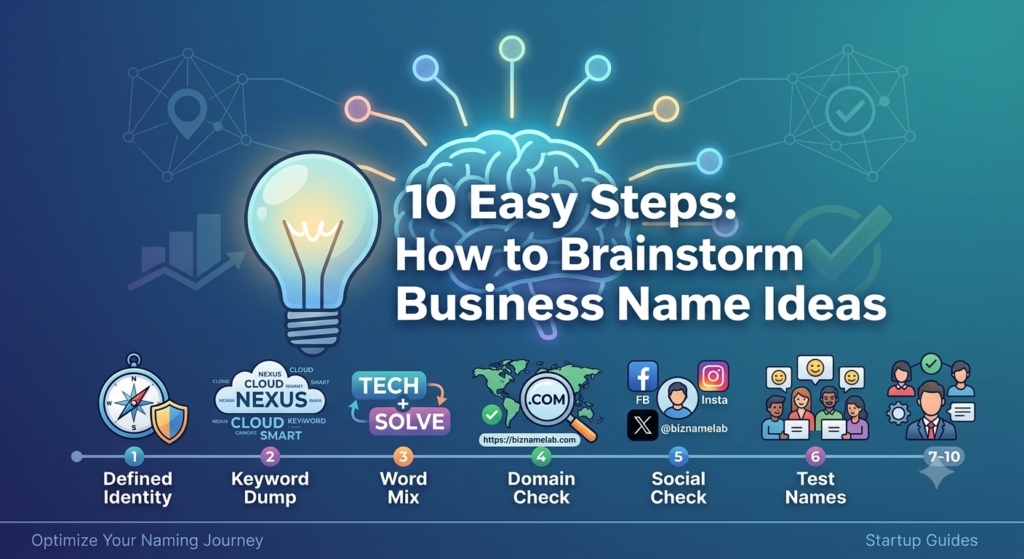
Once you’ve reviewed the lists above, narrowing down to one name takes a bit of structure. Here’s a step-by-step process founders can follow before committing to any option.
- List your core values and product benefits. Write down five words that describe what your software actually does for the customer.
- Combine, shorten, or blend words from that list to create 10–15 candidate names.
- Say each name out loud to test if it’s memorable and easy to pronounce across different accents.
- Check name availability on search engines, app stores, and business registries.
- Shortlist your top three and test them informally with potential customers or your team.
- Confirm a matching .com domain name and consistent social media handles are open.
- Run a formal trademark search before making any public announcement.
You can also use automated naming tools to generate extra options quickly, but treat their output as a starting point — always vet suggestions manually for meaning, pronunciation, and availability before falling in love with one.
Quick Naming Self-Test
- Can a stranger spell it correctly after hearing it once?
- Does it still make sense if you pivot your product in two years?
- Is it free of negative meanings in major languages you’ll operate in?
If you answer “yes” to all three, the name is likely strong enough to move to legal and domain checks.
Common Pitfalls to Avoid When Naming Your Tech Venture
Even experienced founders fall into predictable traps when naming a software company. Here are the common pitfalls to avoid before you print business cards or file paperwork.
- Choosing a name too close to a competitor’s, which risks a competitor’s brand confusion and possible legal disputes.
- Overusing generic tech buzzwords like “Cyber,” “Cloud,” or “AI” stacked together without meaning.
- Ignoring domain and handle availability until after the name feels “final.”
- Picking a name that’s hard to say on a sales call or over a podcast interview.
- Naming around a single feature, which becomes limiting as your product roadmap expands.
- Skipping a trademark search, which can force a costly rebrand later.
A name that feels clever in a brainstorm session can still fail in the real world if it’s legally risky or logistically unavailable — which is exactly why the next section matters.
Digital Clearance: How to Check for Real-World Domain Availability
Before you fall in love with a name, confirm it can actually exist online without conflict. This step protects your investment in logo design, marketing, and building a cohesive online presence from day one.
Start with a basic domain lookup through a registrar, then verify ownership details using ICANN’s Lookup tool to see who currently holds a domain and when it might become available. This is especially useful if a name is technically “taken” but the registration is expired or inactive.
Next, check consistency across platforms. A name might have a matching .com domain name free, but the identical social media handles could already be claimed by an unrelated business. Aim for at least 80% consistency across your top three platforms before finalizing.
| Check | Tool / Method |
|---|---|
| Domain availability | Registrar search (GoDaddy, Namecheap, etc.) |
| Domain ownership history | ICANN Lookup |
| Trademark conflicts | USPTO TESS Search |
| Social handle consistency | Manual check across major platforms |
| App store name conflicts | Search directly in Apple App Store / Google Play |
Running all five checks before launch takes less than an hour and can save months of rebranding pain later.
From Ideation to Brand: Launching and Protecting Your New Identity
Once your name clears domain and handle checks, the legal side deserves equal attention. Conducting a trademark search through the U.S. Patent and Trademark Office database at tmsearch.uspto.gov tells you whether another company already owns rights to a similar name in your industry class.
If the search comes back clear, consider filing an “intent to use” trademark application before your public launch. This locks in your legal claim even if your product is still months from release, which matters more once you start courting enterprise-level clients who will vet your legal standing during procurement.
From there, build your visual identity — logo, color palette, and typography — around the name’s tone. A name like “Nimbus” pairs naturally with soft blues and rounded fonts, while a name like “Vaultlock” suits sharper, darker branding. Consistency here reinforces the brand voice you’ve already chosen and helps you avoid competitor’s brand confusion as you scale.
Finally, register your business entity, secure your domain and handles immediately, and announce your name across owned channels before any public marketing push. For more naming inspiration specific to intelligent products, see this guide on tech and AI company name ideas, or browse the full library at BizNameLab.
Frequently Asked Questions (FAQ) About Software Company Naming
What makes a good name for a software company? A good name is short, easy to pronounce, and flexible enough to cover future products. It should also have an available domain and pass a basic trademark check.
Should my software company name include the word “tech” or “AI”? Not necessarily. These words are heavily used and can make your brand blend in. An abstract or evocative name often stands out more in a crowded market.
How do I know if a name is trademarked? Search the name directly on the USPTO’s trademark database to see if it’s registered in your industry category before using it publicly.
Can I use an automated tool to generate a company name? Yes, automated naming tools are a fast way to generate options, but always manually verify meaning, pronunciation, and availability afterward.
How important is a matching domain name? Very important. A matching .com domain name builds trust and makes it easier for customers to find you without confusion.
What’s the biggest mistake founders make when naming a tech company? Skipping the trademark and domain check until after the name is “final,” which often forces a costly and confusing rebrand later.
Key Takeaways
- A strong software company name idea balances sound, meaning, and long-term flexibility.
- One-word, abstract, and industry-specific names each serve different brand personalities.
- Always verify domain availability, social handles, and trademarks before finalizing a name.
- Avoid buzzword overload and names too close to a competitor’s identity.
- Protect your brand early with a formal trademark filing through the USPTO.
Conclusion
Naming a software company is part creative exercise, part legal homework — and both halves matter equally. With 120+ curated ideas and a clear checklist for domain, trademark, and brand consistency, you now have everything needed to move from brainstorm to a name you can build a lasting company around. Take your shortlist, run it through the checks above, and move forward with confidence.