How to trademark a business name: Search the USPTO’s TESS database for conflicts, choose the correct trademark class for your goods or services, file a formal application through the USPTO’s TEAS system, respond to any Office Actions from an examining attorney, and maintain your registration with required filings every 10 years.
Introduction
Figuring out how to trademark a business name is one of the smartest moves a founder can make before scaling. A registered mark does more than look official on paper — it becomes the legal backbone of your brand identity, giving you the power to safeguard your brand as it grows. Without it, you risk building years of goodwill around a name someone else could legally claim. This guide walks you through the entire USPTO process, from your first search to long-term maintenance, so you can move forward with confidence instead of guesswork. Let’s start with the fundamentals.
Understanding the Basics: What Exactly Is a Trademark?
A trademark is any word, logo, symbol, or distinctive sign that identifies the source of goods or services and separates them from everyone else’s. Think of it as a legal fingerprint for your brand. It’s a category of intellectual property, alongside patents and copyrights, but it specifically protects branding rather than inventions or creative works.
Most people picture trademarks as brand names or logos, but the legal definition is broader. Here’s a quick breakdown of the main types you’ll encounter:
| Type | What It Covers | Example |
| Trademark | Physical goods or products | Nike’s swoosh on shoes |
| Service mark | Services rather than physical products | FedEx for delivery services |
| Collective mark | Membership in an organization or group | CPA for accountants |
| Certification mark | Products meeting a specific standard | UL for electrical safety |
Understanding how to trademark your business name starts with recognizing which category your brand falls into, since that shapes how you’ll classify your application later. A software company, for instance, usually needs a service mark rather than a traditional product trademark.
It’s also worth noting that a trademark isn’t the same as a business name registration with your state, and it isn’t a copyright either. Copyright protects creative works like software code or marketing copy, while a trademark protects the identifiers customers use to recognize you in the marketplace.
Strategic Advantages: What a Registered Trademark Does for Your Business
A federal trademark registration isn’t just a formality — it’s a business asset that pays dividends for years. Once you understand what it actually does, the filing fee starts to look like one of the cheapest insurance policies you’ll ever buy.
Nationwide legal protection. Federal registration gives you exclusive rights to use your mark across the entire United States, not just the city or state where you operate. This matters enormously for e-commerce and SaaS companies that sell nationally from day one.
Stronger legal standing. If someone infringes on your mark, a federal registration lets you take legal action in federal court and pursue statutory damages. Without registration, you’re often limited to proving actual damages in state court, which is slower and harder.
Marketplace clarity. A registered mark helps prevent confusion in the marketplace by making it legally risky for competitors to adopt a confusingly similar name. This protects your customers as much as it protects you.
Competitive deterrence. The registration itself acts as a public record that can deter competitors from even attempting to use a similar name, since it signals you’re prepared to defend it.
Brand equity growth. As your business grows, your name becomes valuable in its own right. Registration protects that value and prevents anyone from diluting its value through unauthorized or copycat use.
Global filing foundation. A US registration can serve as the basis for international trademark applications later, which matters if you’re planning to expand overseas.
The Decision Matrix: Do You Actually Need a Trademark Right Now?
Not every founder needs to file on day one. The right call depends on your stage, budget, and growth plans. Use this table to assess your specific needs honestly before spending money.
| Situation | Trademark Priority |
| Pre-revenue idea stage, still testing concepts | Low — wait until the name is finalized |
| Raising a seed round or applying for a trademark-backed loan | High — investors expect it |
| Selling products/services across state lines | High — federal protection matters |
| Local-only service business (e.g., a single café) | Medium — state registration may suffice |
| Building a scalable tech product or app | High — file early before competitors do |
| Name is highly generic or descriptive | Low priority until you can strengthen it |
If you’re operating a local bakery that has no plans to expand, a state-level registration might genuinely be enough for now. But if you’re building anything with national ambitions — an app, a SaaS product, an online store — filing early protects you from the nightmare scenario of being forced to rename your business after you’ve already built brand recognition.
A good rule of thumb: file once your name is stable, your logo is close to final, and you’re actively using the mark in commerce or planning to within the next few months.
Common Trademarking Challenges and Pitfalls for Tech Startups
Tech founders move fast, and that speed often creates trademark blind spots. Here are the mistakes that show up again and again.
Choosing a name that’s already crowded. Many startups fall in love with a name before checking availability, only to discover a similar app or platform already owns rights in their category. Learning from current tech startup branding trends can help you avoid picking a name pattern that’s already saturated, like generic “.ai” or “.io” combinations that are hard to distinguish legally.
Assuming a domain name equals a trademark. Owning a .com or .io domain gives you zero trademark rights. It’s entirely possible to own a domain and still face a cease-and-desist letter from a trademark holder.
Picking overly descriptive names. Names that simply describe the product (like “Fast Cloud Storage”) are difficult to register because they’re not considered legally distinctive signs. Weak marks are also easier for competitors to copy.
Delaying the search process. Waiting too long to start searching the United States Patent and Trademark Office database means you might invest in branding, packaging, and marketing around a name you can’t legally keep.
Ignoring international overlap. If you plan to expand globally, a name that’s clear in the US might conflict with an existing mark abroad, creating headaches down the road.
Underestimating classification complexity. Tech companies often provide both software and services, which means they may need to file under multiple classes — a detail many first-time founders miss, leading to gaps in protection.
For deeper guidance on choosing and vetting a startup name before you fall in love with it, resources like biznamelab.com offer naming and branding tools built specifically for founders navigating this exact stage.
The Step-by-Step Blueprint to Register Your Business Name with the USPTO
Here’s the practical, no-fluff process for getting your formal application filed correctly the first time.
Step 1: Conduct a Comprehensive Trademark Search
Before anything else, search existing trademark registrations through the USPTO’s TESS database. Look for identical names, phonetic variations, and similar logos in your industry category. This step alone prevents most rejections.

Step 2: Define Your Goods and Services Classification
The USPTO organizes trademarks into 45 international classes. Software companies often fall under Class 9 (downloadable software) or Class 42 (SaaS and technology services). Choosing the wrong class can delay or derail your application.
Step 3: Confirm Your Filing Basis
You’ll need to file based on either “use in commerce” (you’re already selling under the name) or “intent to use” (you plan to soon). Each has different documentation requirements.
Step 4: Prepare Your Application Materials
Gather your business name, a clear description of goods/services, a specimen showing real-world use (like a screenshot of your website or product packaging), and the appropriate filing fee.
Step 5: File Through TEAS
Submit your formal application using the USPTO’s Trademark Electronic Application System (TEAS). Double-check every field, since errors here are a common cause of delays.
Step 6: Respond to Office Actions
An examining attorney will review your filing. If they raise concerns, they’ll issue an “Office Action,” and you’ll typically have three months to respond with corrections or legal arguments.
Step 7: Publication and Opposition Period
Once approved, your mark is published in the Official Gazette for 30 days, giving the public a chance to oppose it if they believe it conflicts with their own rights.
Step 8: Registration Certificate
If no one opposes your mark (or oppositions are resolved in your favor), the USPTO issues your official registration certificate — congratulations, your mark is now protected.
Navigating the Legal Landscape: Understanding Strong vs. Weak Trademarks
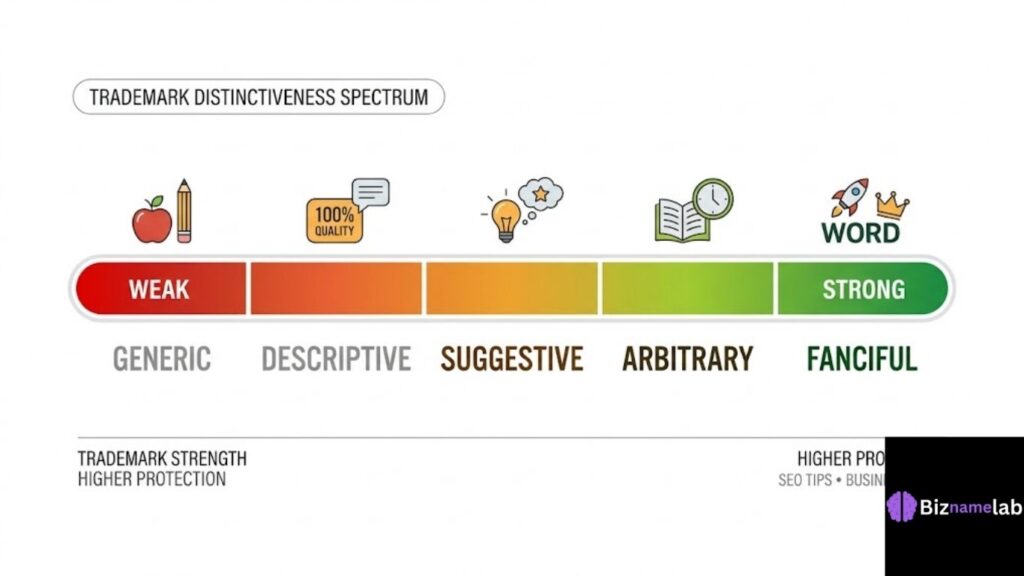
Not all trademarks offer the same level of protection. The USPTO and courts evaluate trademarks along a “strength spectrum,” and knowing where your name falls can save you from major legal headaches later.
Fanciful marks are invented words with no dictionary meaning, like “Kodak” or “Xerox.” These are the strongest possible marks because they’re inherently distinctive signs with no prior meaning to conflict with.
Arbitrary marks use real words applied to unrelated products, like “Apple” for computers. These are also very strong since the word has nothing to do with the product itself.
Suggestive marks hint at a quality of the product without directly describing it, like “Netflix” suggesting internet-delivered films. These are moderately strong and commonly used by startups.
Descriptive marks directly describe the product or service, like “Best Cloud Storage.” These are weak and often rejected unless you can prove the public already associates the name specifically with your brand.
Generic terms simply name the product category itself, like calling a software company “Software Company.” These can never be trademarked, no matter how much marketing you do behind them.
Choosing a name higher on this spectrum makes it easier to register, easier to defend, and far more effective at guarding against copycats who might otherwise try to ride on your brand’s coattails.
Timeline and Expectations: How Long Does the Trademark Process Take?
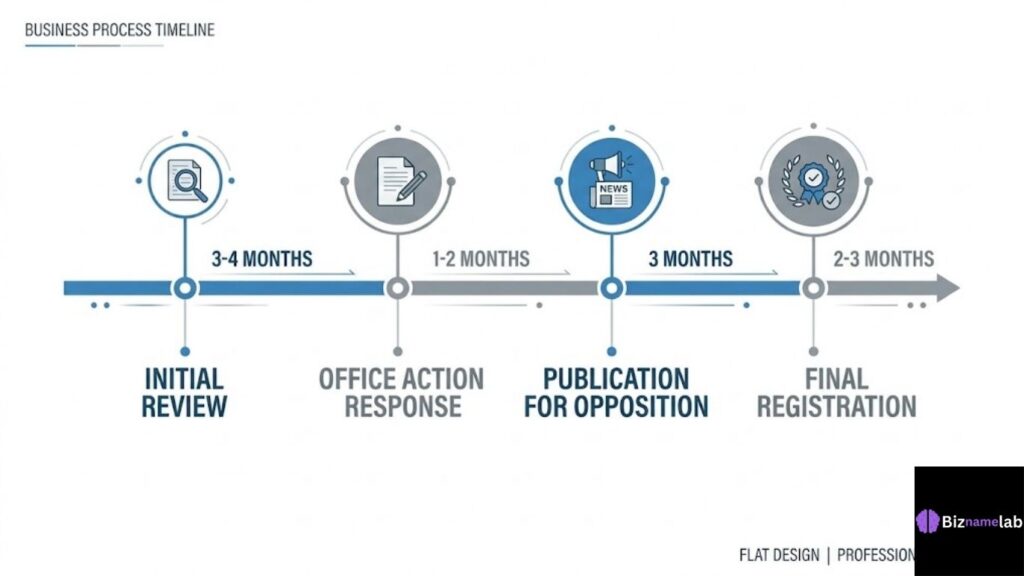
Patience matters here — this isn’t an overnight process. On average, a straightforward US trademark application takes 8 to 14 months from filing to registration, assuming there are no complications.
| Stage | Typical Duration |
| Initial USPTO review (assigned to examiner) | 3–4 months |
| Office Action response window (if issued) | Up to 3 months |
| Publication for opposition | 30 days |
| Final registration issuance | 2–3 months after publication |
Applications filed under “intent to use” can take longer, since you’ll need to submit proof of actual use before registration completes. Complicated cases involving Office Actions or third-party opposition can stretch the timeline well beyond a year, so it pays to start early rather than waiting until you’re under pressure to launch.
Maintenance and Longevity: How Long Does a Legal Trademark Last?
Here’s some good news: a trademark can theoretically last forever, as long as you keep using it and file the required maintenance paperwork on schedule.
Federal trademarks must be renewed every 10 years, and you’re also required to file a Declaration of Use between the 5th and 6th year after registration to confirm the mark is still active in commerce. Skipping these deadlines is one of the most common — and entirely avoidable — ways businesses lose protection.
To keep your registration alive, you’ll need to periodically demonstrate continued use of the mark through updated specimens showing it’s still actively representing your goods or services. Think of maintenance less as a bureaucratic chore and more as routine upkeep, similar to renewing an insurance policy that protects something valuable.
Smart Alternatives to Federal Trademarks (Common Law & State Registration)
Federal registration isn’t the only path to protection, and for some early-stage businesses, it might not be the right first move.
Common law trademark rights exist automatically the moment you start using a name in commerce, even without any registration. These rights are limited to the specific geographic area where you actually do business, but they do give you some standing to take action against any infringement within that region.
State trademark registration is cheaper and faster than federal filing, and it can be a smart interim step for local businesses like restaurants, salons, or regional service providers. It won’t protect you nationwide, but it strengthens your legal position within your state.
The ™ symbol can be used with any name you’re claiming rights to, registered or not, as a public signal of your claim. The ® symbol, however, is legally reserved for names with active federal registration — using it prematurely can create legal problems.
For founders who aren’t ready for the full federal process, combining a state registration with careful common law documentation (invoices, marketing materials, dated screenshots) creates a reasonable safety net until you’re ready to file federally.
Frequently Asked Questions (FAQ) Regarding Business Name Trademarks
1. How do I trademark a name for free?
There’s no way to get an official USPTO registration entirely for free — filing fees are mandatory. However, you can establish common law rights at no cost simply by using your name in commerce and keeping dated records of that use.
2. What is the cheapest way to trademark a name?
Filing directly through the USPTO’s TEAS Plus option, without hiring an attorney, is typically the most affordable route. Filing your own comprehensive search first also avoids paying for a professional clearance search.
3. Can I file a trademark myself?
Yes. The USPTO allows individuals and business owners to file applications themselves through TEAS. It’s more time-consuming than hiring a trademark attorney, but entirely possible for straightforward cases.
4. Can I do a TM search myself?
Yes, you can search the USPTO’s free TESS database yourself to check for conflicting marks before filing. It takes some practice to search effectively across spelling variations and phonetic matches.
5. How do you legally trademark a name?
You legally trademark a name by filing a formal application with the USPTO, specifying your goods or services class, proving use (or intent to use) in commerce, and successfully passing examination and the opposition period.
6. What are the 7 types of trademarks?
While the USPTO formally recognizes trademarks and service marks, marks are often categorized into seven practical types: word marks, logo marks, slogan marks, sound marks, collective marks, certification marks, and trade dress.
Protect Your Next Big Idea: Verify and Secure Your Digital Assets Today
Your business name is often the very first asset you create, long before your first sale or your first customer. Treating it with the same seriousness as your product roadmap or funding strategy isn’t overkill — it’s foundational business hygiene.
Before you fall in love with a name, run it through a naming and clearance process that checks for unauthorized use risks, domain availability, and social handle conflicts all at once. Platforms like biznamelab.com are built to help founders vet names early, reducing the odds you’ll ever need to change course mid-growth.
Whether you’re just brainstorming or ready to file, the smartest move is treating your name as intellectual property from day one — not an afterthought you’ll deal with later.
Key Takeaways
- A trademark protects your brand identity and legally separates your name from competitors’ names.
- Federal registration gives nationwide protection; common law and state rights are more limited but still useful.
- Search the USPTO’s TESS database before filing to avoid conflicts and wasted fees.
- Strong marks (fanciful, arbitrary, suggestive) are easier to register and defend than descriptive or generic names.
- Registration typically takes 8–14 months and must be renewed every 10 years to stay active.
- Tech startups should watch for classification errors and overly generic name patterns.
- You can file a trademark application yourself, but professional help reduces the risk of costly mistakes.
Conclusion
Trademarking your business name isn’t just legal paperwork — it’s one of the most protective moves you can make as a founder. From understanding how to trademark your business name to navigating classifications, timelines, and renewals, the process rewards founders who plan ahead rather than react after a conflict arises. Start with a thorough search, choose a strong and distinctive sign, and treat registration as an investment in your company’s long-term identity rather than a box to check.