
Table of Contents
- what-is-business-rebranding”>What is Business Rebranding (And When is a Name Change Necessary?)
- Weighing the Options: Key Reasons to Change vs. Keep Your Existing Business Name
- Consider a DBA (Doing Business As) Name Before Making a Full Legal Leap
- The Legal Step-by-Step Guide: How to Legally Rename Your Business
- Conduct a Deep Name Search and Trademark Availability Check
- How to File Articles of Amendment to Update Your LLC or Corporation Title
- How to Maintain Existing Name Rights (Protecting Your Old Brand)
- Beyond the Paperwork: Legal and Operational Checklist for Rebranding
- Digital Transition: How to Switch Domains and Social Handles Safely
- Common Rebranding Mistakes That Can Hurt Your Market Authority
- Conclusion: Ready for a Fresh Start? Brainstorm Your New Identity Today
- Business Rebranding and Name Change FAQs
Introduction
Learning how to rename your business the right way can protect years of hard-earned trust while opening the door to new growth. A name change isn’t just a creative decision — it’s a legal one, touching everything from your LLC operating agreement to your tax records. This guide walks you through legally changing your business name step by step, so you can ensure a smooth transition, preserve valuable brand equity, and protect it against intellectual property infringement. Whether you’re rebranding fully or just testing a new identity with a DBA, here’s exactly where to start.
What is Business Rebranding (And When is a Name Change Necessary?)
Rebranding your business means updating how your company presents itself to the world — your name, logo, messaging, or all three. Sometimes rebranding is cosmetic, like a fresh logo. Other times it requires a full legal name change, which is a much bigger undertaking involving state filings, tax agencies, and contracts.
A legal name change becomes necessary in a few common situations. Maybe your company has outgrown its original name after a pivot in products or services. Maybe two businesses merged and need one unified identity. Or maybe a trademark dispute forced your hand, and continuing to use the old name risks a costly legal fight.
Other triggers include expanding into new markets where your current name is already taken, or simply outgrowing a name that no longer reflects your mission. Whatever the reason, the earlier you plan the legal side, the fewer surprises you’ll face later — especially around taxes, banking, and existing contracts tied to your old business name.
Weighing the Options: Key Reasons to Change vs. Keep Your Existing Business Name
Before filing anything, it’s worth honestly weighing whether a rename is truly the best move. A name change can unlock growth, but it also comes with real costs and operational challenges of rebranding that shouldn’t be underestimated.
Reasons to change your business name:
- The current name limits growth into new products, services, or geographic markets.
- A trademark conflict puts your brand at legal risk.
- The name feels outdated or no longer matches your company’s mission.
- A merger, acquisition, or ownership change requires a unified identity.
- Negative associations (a scandal, a bad review cycle, or a confusing name) are hurting sales.
Reasons to keep your existing name:
- You’ve built significant brand recognition, SEO rankings, or word-of-mouth referrals tied to the current name.
- Rebranding costs (legal fees, new signage, marketing, domain purchases) outweigh the benefit.
- Loyal customers strongly associate your name with quality and trust.
| Factor | Change the Name | Keep the Name |
| Brand recognition | Starts to rebuild | Already established |
| Legal risk | May resolve trademark issues | May continue existing exposure |
| Cost | Higher upfront investment | Lower short-term cost |
| SEO & online authority | Temporary dip likely | Preserved |
| Growth flexibility | Improved | Limited if name is restrictive |
If you’re still torn, a smaller step like filing a DBA can help you test a new identity without fully committing to a legal name change yet.
Consider a DBA (Doing Business As) Name Before Making a Full Legal Leap
Not every business needs to change its legal name to feel like a new company. File a DBA, also called a fictitious business name, and you can operate under a new brand while your legal entity name stays exactly the same on record with the state.
A DBA is ideal if you want to test a new market segment, launch a sub-brand, or simply present a friendlier name to customers without touching your LLC operating agreement or corporate charter. It’s typically faster and cheaper than a full legal rename, often costing between $10 and $100 depending on your state and county.
Keep in mind a DBA does not offer trademark protection on its own, and it doesn’t change your entity’s legal name for tax or liability purposes. If your goal is a complete identity overhaul — new legal name, new EIN records, new contracts — you’ll eventually need the full legal process covered below.
The Legal Step-by-Step Guide: How to Legally Rename Your Business
Once you’ve decided a full legal rename is the right move, following a clear sequence keeps the process organized and reduces the risk of missed steps. Here’s the complete roadmap.
- Research and choose your new name — confirm it’s original, memorable, and available.
- Run a deep name and trademark search to avoid legal conflicts.
- Get formal approval from LLC members or the corporate board.
- File Articles of Amendment with your state’s Secretary of State.
- Update your EIN and IRS records to reflect the new legal name.
- Update licenses, permits, and registered agent filings.
- Notify banks, vendors, and contract holders of the change.
- Transition your digital presence — domain, website, and social handles.
Each of these steps deserves its own attention, so let’s break down the two most critical legal actions: the trademark search and the Articles of Amendment filing.
Conduct a Deep Name Search and Trademark Availability Check
Skipping this step is one of the most expensive mistakes a business owner can make. Before you fall in love with a new name, run a trademark search through the USPTO database at uspto.gov/trademarks/search to confirm no one else already holds rights to it nationally.
Next, complete a Preliminary state name check through your Secretary of State website to make sure the name isn’t already registered by another business entity in your state. Most states offer a free online search tool for this.
Don’t stop there. A truly deep name search should also cover:
- Domain name availability across major extensions (.com, .co, .net).
- Social media handle availability on the platforms your customers use.
- A general web search to catch unregistered but actively used business names.
- Business entity filing records in any state where you plan to do business.
This layered check protects you from intellectual property infringement claims down the road and saves you from rebuilding your brand a second time after a costly legal dispute.
How to File Articles of Amendment to Update Your LLC or Corporation Title
Once your new name clears every search, it’s time to make it official. To comply with LLC or corporate law, most states require you to file Articles of Amendment (sometimes called a Certificate of Amendment) with the Secretary of State’s office.
Here’s the typical filing process:
- Get internal approval first. The name change must be approved by the members of your LLC or by your corporation’s board and, in some cases, shareholders. Document this vote in your meeting minutes.
- Complete the Articles of Amendment form. This is usually available directly on your Secretary of State website, either as a downloadable PDF or an online filing portal.

- Pay the filing fee. Fees vary by state, typically ranging from $20 to $150.
- Submit and wait for confirmation. Processing times range from same-day online filings to a few weeks by mail.
- Request updated certificates. Ask for a certified copy showing your new legal name — you’ll need this for banks and vendors.
If your company operates in multiple states, don’t forget foreign qualification in other states, which means updating your name on record everywhere you’re registered to do business, not just your home state.
How to Maintain Existing Name Rights (Protecting Your Old Brand)
Changing your business name doesn’t necessarily mean abandoning all rights to your old one — and in many cases, you shouldn’t. To fully maintain its trademark rights, consider keeping your old trademark registration active for a transition period, especially if competitors might try to claim the abandoned name.
A few practical ways to protect your old brand:
- Keep the old trademark registration active until the transition is complete.
- Register your old name as a DBA under your new legal entity, preventing others from using it.
- Maintain ownership of the old domain name and redirect it to your new site.
- Archive old marketing materials and contracts referencing the previous name for legal records.
This layered protection matters most if your old name still carries goodwill or if there’s any chance you’ll reintroduce it later, such as for a sub-brand or a specific product line.
Beyond the Paperwork: Legal and Operational Checklist for Rebranding
Filing state paperwork is only part of the process. A complete business name change checklist should also cover taxes, banking, and daily operations that quietly rely on your business name.
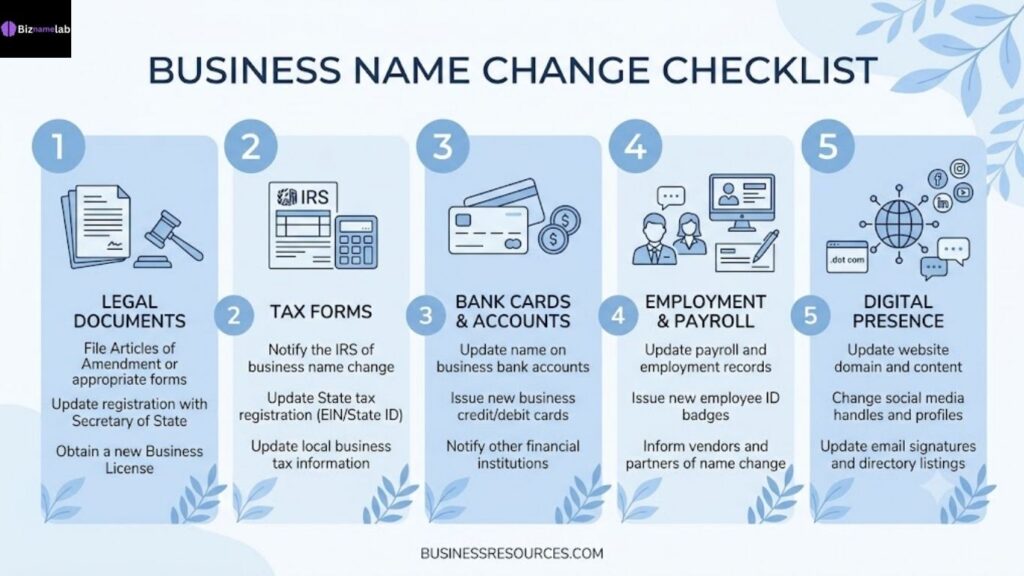
| Task | Why It Matters |
| Update EIN records with the IRS | Keeps tax filings accurate and penalty-free |
| Update business bank accounts | Prevents payment and deposit disruptions |
| Notify vendors and suppliers | Avoids invoicing and contract confusion |
| Update business licenses and permits | Keeps you compliant with local regulations |
| Amend contracts and leases | Protects enforceability under the new name |
| Update insurance policies | Ensures coverage remains valid |
| Update signage and printed materials | Maintains a consistent public identity |
To formally notify the IRS of your name change, LLCs and corporations typically write to the IRS at the address where they file their return, or update the name during their next tax filing, depending on entity type. Sole proprietors usually just need to check the name-change box on their next Form 1040.
Digital Transition: How to Switch Domains and Social Handles Safely
Your online presence needs just as much care as your legal filings. A rushed digital transition can confuse customers and even create security risks, so plan this phase carefully.

Start by securing your new domain name well before launch, and hold onto your old domain for at least 12 months. Set up a 301 redirect from the old site to the new one so visitors and search engines land in the right place automatically. This step also helps prevent hackers from re-registering the domain name once you stop actively using it.
For social media, update your handles gradually rather than all at once:
- Reserve your new handle names as early as possible, even before you’re ready to launch.
- Update your profile bios and pinned posts to announce the change clearly.
- Keep old handles active with a note directing followers to the new one.
- Update Google Business Profile, directory listings, and review platforms to match your new name.
If your rebrand touches your core content strategy, it’s also a good time to revisit your original naming process — our guide on how to brainstorm business name ideas can help you validate the new name from a branding and marketing angle, not just a legal one.
Common Rebranding Mistakes That Can Hurt Your Market Authority
Even well-funded rebrands can backfire when key steps get rushed or skipped entirely. Watch out for these common missteps.
Skipping the trademark search. Falling in love with a name before confirming it’s legally available is one of the fastest ways to end up in a costly dispute.
Changing everything at once. Abrupt, uncoordinated changes across your website, signage, and socials confuse loyal customers and can dilute brand trust built over years.
Ignoring SEO continuity. Failing to set up proper redirects or update backlinks can tank your search visibility overnight, undoing years of content and authority-building work.
Forgetting internal documentation. Contracts, licenses, and your LLC operating agreement still referencing the old name can create legal ambiguity if disputes arise later.
Underestimating the timeline. A full rebrand — legal, operational, and digital — often takes three to six months to execute properly. Rushing it increases the odds of costly errors.
Conclusion: Ready for a Fresh Start? Brainstorm Your New Identity Today
Renaming your business is a big move, but with the right legal groundwork — from trademark searches to Articles of Amendment — it doesn’t have to be overwhelming. Take it step by step: clear the name, file the paperwork, update your records, and transition your digital presence with care.
If you’re still shaping your new identity, start with a strong foundation. Explore our guide on how to brainstorm business name ideas to generate options that are both legally sound and memorable to your customers.
Key Takeaways
- A legal business name change requires more than creativity — it involves trademark checks, state filings, and IRS updates.
- A DBA is a lower-cost way to test a new name before committing to a full legal rename.
- Always run a deep name search covering trademarks, state records, and domains before finalizing your choice.
- Filing Articles of Amendment with your Secretary of State makes the name change official at the entity level.
- Protect your old brand by keeping trademarks or DBAs active during the transition.
- A full rebrand touches taxes, banking, contracts, and your entire digital presence — plan for three to six months.
Business Rebranding and Name Change FAQs
What is the cheapest way to change a business name?
Filing a DBA is usually the cheapest route, often costing between $10 and $100 depending on your state and county. A full legal name change through Articles of Amendment costs more, typically $20 to $150 in state filing fees, plus any costs for updated licenses, signage, and marketing materials.
Can I keep my old business bank account after a name change?
In most cases, you can keep the same bank account, but you’ll need to provide your bank with updated formation documents showing the new legal name. Some banks may require you to open a new account instead, so it’s best to check with your specific bank early in the process.
Does renaming my website affect my existing Google rankings?
Yes, it can cause temporary ranking fluctuations, especially if you change your domain name. Setting up proper 301 redirects, updating your Google Business Profile, and keeping your content structure consistent can minimize disruption and help rankings recover faster.
Do I need a new EIN (Employer Identification Number) when I rename my business?
Usually not. Most businesses keep the same Employer Identification Number (EIN) after a name change and simply notify the IRS of the update. A new EIN is typically only required if the business structure itself changes, such as converting from a sole proprietorship to an LLC.