Tech startups are dropping .com for .ai and .io because premium .com names are scarce, expensive, and often unavailable, while .ai instantly signals artificial intelligence authority and .io signals technical, developer-first credibility. Both extensions rank on Google exactly like .com when paired with strong content and backlinks.
Introduction
Tech Startup Branding Trends in 2026 point to one clear pattern: founders are walking away from .com and picking .ai or .io instead. Why? Because premium domain names ending in .com are either taken, priced out of reach, or simply don’t fit a company built on artificial intelligence brand authority. This shift is reshaping how investors, engineers, and customers judge a company before they’ve even opened the homepage. In this guide, we’ll break down exactly why this is happening, what it means for your SEO, and how to decide which extension fits your startup’s identity.
The Premium Domain Crisis: Why the .com Monopoly is Fading
For twenty years, a strong .com was considered non-negotiable. Today, most short, brandable words are already registered, resold, or parked by domain investors asking six figures. This scarcity has quietly ended the dot com monopoly that once defined credible business branding.
New startups face a simple math problem. There are only so many short, memorable English words, and millions of companies have launched since 1995. Combined with rising domain registration costs for resale-market .com names, founders are forced to either compromise on a weaker name or look elsewhere entirely.
This is where top-level domains (TLDs) beyond .com enter the picture. Extensions like .ai, .io, .co, and .dev were once seen as fallback options. Now they’re often the first choice, not the last resort, especially among companies building AI products or developer tools.
| Domain Trend | 2015 Reality | 2026 Reality |
| .com availability for short brand names | Limited but findable | Nearly exhausted |
| Founder attitude toward .io/.ai | Backup option | Primary choice |
| Average resale price for premium .com | High | Often prohibitive |
Decoding the Shift: What Makes .ai and .io Irresistible to Tech Founders
Alternative domain extensions aren’t winning by default — they’re winning because they actively communicate something .com can’t. A .ai domain tells visitors “we build intelligent software” before they read a single word of copy. A .io domain tells them “we’re technical, fast, and built for builders.”
This is part of a broader wave of Silicon Valley naming trends where the domain itself becomes a piece of brand storytelling. Founders increasingly treat the extension as functional copywriting, not just a web address.
Three forces are driving this switching from dot com to dot io and .ai pattern:
- Availability — short, punchy names are still findable on newer TLDs.
- Relevance — the extension reinforces what the company actually does.
- Cultural signaling — using .ai or .io shows founders are plugged into current tech culture, not chasing outdated conventions.
The Cognitive Branding Physics: How Domain Extensions Shape Investor Perception
Domain choice isn’t just aesthetic — it triggers real psychological associations. This is cognitive branding for tech companies: the extension acts as a micro-signal that shapes first impressions in milliseconds, long before a pitch deck or product demo happens.
Investor perception of alternative domains has shifted noticeably over the past few years. A .ai or .io suffix on a pitch deck’s URL no longer reads as unconventional — it reads as intentional. Investors scanning dozens of deals a week often use domain choice as a quick, informal signal of category fit.

That said, perception cuts both ways. A .io domain on a company with nothing to do with software can feel confusing. A .ai domain with no actual AI functionality can feel like overreach. The extension should match the product story, not just chase a trend.
The Explosive Rise of .ai: Crowdsourcing Instant Tech and Artificial Intelligence Authority
Few TLD stories move as fast as .ai. Originally the country code for Anguilla, it’s now practically synonymous with why startups choose dot ai: instant category signaling in the most competitive tech sector on earth.
Artificial intelligence brand authority is hard to build from scratch through content and messaging alone. A .ai domain shortcuts that process by association. Visitors, journalists, and investors immediately place the company in the AI conversation, which matters enormously when attention spans are short and competition is loud.
There are trade-offs worth knowing:
- Higher renewal costs compared to standard .com pricing.
- Country-code TLD status, meaning registry policy can occasionally shift.
- Crowded competitive space, since thousands of startups now share the same extension.
Despite this, the momentum behind .ai shows no sign of slowing, particularly for companies whose entire value proposition centers on machine learning, automation, or generative tools.
The Technical Appeal of .io: The Definitive Signal for Software Developers and Engineers
If .ai speaks to intelligence, .io speaks to engineering. Technically, “io” stands for input/output — a term every developer recognizes instantly. That built-in relevance makes .io a natural domain extension for software developers, API platforms, and dev-tool startups.
Developer-first companies gravitate here because the audience they’re targeting already associates .io with GitHub repos, documentation sites, and technical products. It signals “built by engineers, for engineers” without needing extra copy to explain it.
Popular use cases include:
- Developer tools and APIs
- SaaS platforms targeting technical buyers
- Open-source projects and communities
- Infrastructure and cloud-native startups

Because the audience for .io sites is often highly technical, they’re generally less swayed by traditional consumer branding cues and more influenced by functionality, documentation quality, and community trust.
Evaluating Cost vs. Brand Equity: The Financial Realities of Modern TLD Extensions
Money matters here, and founders should go in with clear eyes. Domain registration costs for .ai and .io typically run higher annually than a standard .com — sometimes two to five times more, depending on the registrar and name length.
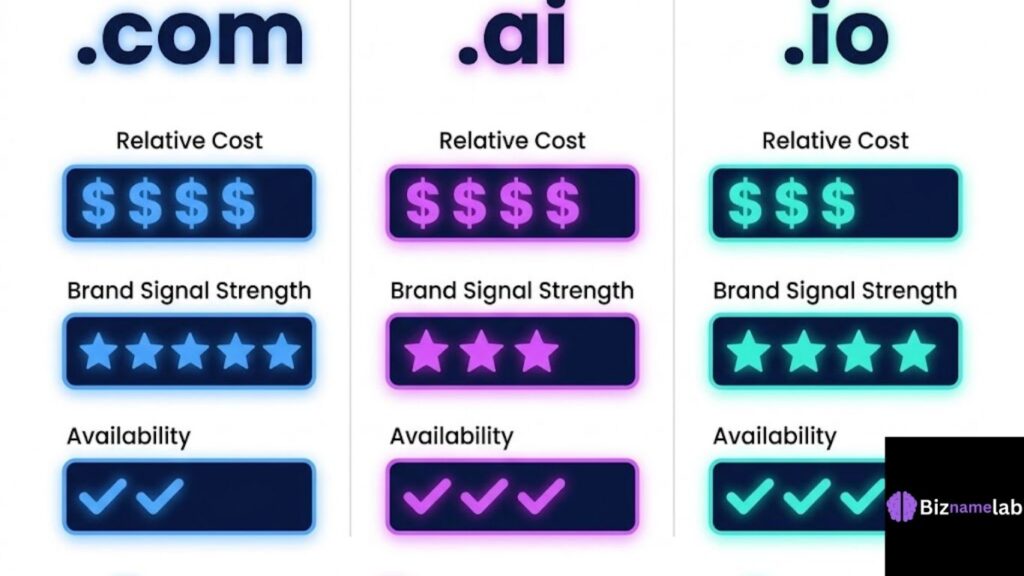
Founders weighing tech startup branding decisions need to balance that ongoing cost against what they’d otherwise spend acquiring a premium .com on the resale market, which can run into the thousands or tens of thousands of dollars for a strong, short name.
| Factor | .com | .ai | .io |
| Typical annual cost | Low | Higher | Higher |
| Premium resale pricing | Very high for short names | Moderate to high | Moderate to high |
| Brand equity and equity value build-up | Slower differentiation | Fast category signal | Fast technical signal |
Ultimately, the real cost comparison isn’t domain price versus domain price — it’s domain price versus the marketing spend needed to explain your category without a self-explanatory extension.
Real-World SEO Realities: Do Alternative Domain Extensions Hurt Your Google Rankings?
This is the question founders ask most, and the honest answer is reassuring: does dot io domain hurt SEO? No — not directly. Google has repeatedly confirmed that TLD choice itself is not a ranking factor. Sites on .ai and .io compete on equal footing with .com when it comes to core algorithmic signals.
What actually matters for rankings:
- Quality, original content that answers search intent.
- Backlinks from relevant, authoritative sites.
- Site speed, mobile usability, and technical health.
- Consistent branded search volume over time.
The one indirect factor worth noting: newer or less common TLDs can occasionally see slightly lower click-through rates from users unfamiliar with the extension, simply because .com still feels more “default” to some searchers. That’s a user-behavior nuance, not a ranking penalty, and it tends to fade as a brand becomes established.
The Cybersecurity Angle: Trust and Verification Protocols for Alternative TLDs
Cybersecurity trust and verification protocols are a legitimate part of this conversation. Because .ai is a country-code domain, it operates under Anguilla’s registry rules rather than the more globally standardized system governing .com and .io.
For founders, this means doing basic due diligence: verifying registrar reputation, enabling two-factor authentication on domain accounts, and using registrar lock features to prevent unauthorized transfers. Securing next-gen digital identity also means setting up proper SSL certificates and email authentication (SPF, DKIM, DMARC) regardless of which TLD you choose.
Security researchers have periodically flagged that phishing actors sometimes exploit unfamiliar TLDs because users are less trained to scrutinize them. This isn’t a reason to avoid .ai or .io — it’s a reason to invest early in visible trust signals like verified badges, clear About pages, and transparent contact information.
Strategic Framework: When to Choose .ai/.io Over a Compromised .com Name
Not every startup should switch. Here’s a practical decision framework for evaluating compromised dot com solutions versus a clean alternative extension.
Choose .ai when:
- Your core product involves machine learning or automation.
- You want instant category recognition in AI-heavy markets.
- Your target .com is unavailable or prohibitively expensive.
Choose .io when:
- You’re building developer tools, APIs, or infrastructure.
- Your primary users are technical (engineers, IT teams).
- You want a shorter, cleaner name than a compromised .com allows.
Stick with .com when:
- You’re targeting a broad, non-technical consumer audience.
- Trust and familiarity outweigh category signaling.
- A strong, available .com genuinely matches your brand name.
The right call depends on audience, not trend-chasing. A consumer fintech app aimed at everyday users may still benefit more from .com’s universal familiarity than from a technical-sounding .io.
Frequently Asked Questions (FAQ) Regarding Tech Startup Domain Extensions
Is .ai only for artificial intelligence companies? No, but it’s strongly associated with AI, so non-AI companies using it may confuse visitors about what the product actually does.
Can I switch from .com to .io later without losing SEO progress? Yes, with a proper 301 redirect migration, though some temporary ranking fluctuation is normal during the transition.
Are .ai domains more expensive to renew every year? Generally yes, often several times the cost of a standard .com renewal, depending on the registrar.
Do investors actually care about domain extension? Many notice it as a quick signal of category fit, though strong metrics and product traction matter far more in due diligence.
Is .io a good choice for a consumer mobile app? It can work, but .io leans technical, so consumer-facing apps sometimes perform better with .com or .app for broader familiarity.
Lock In Your Next-Gen Digital Asset: Deploy Our AI Naming Engine Today
Choosing between .com, .ai, and .io shouldn’t be guesswork. If your ideal .com is taken or overpriced, BizNameLab’s software company name generator helps you find available, brandable names across every major extension — built specifically for founders navigating today’s tech startup branding landscape. Explore it here : biznamelab.com.
Key Takeaways
- The dot com monopoly is fading due to scarcity and rising resale prices for short, brandable names.
- .ai signals artificial intelligence authority instantly; .io signals technical, developer-first credibility.
- TLD choice is not a direct Google ranking factor — content quality and backlinks matter far more.
- Domain registration costs for .ai and .io typically run higher annually than .com.
- Security best practices (2FA, registrar lock, SSL, DMARC) matter more than which TLD you pick.
- Match your extension to your actual audience — don’t chase the trend blindly.
Conclusion
The move away from .com isn’t a fad — it’s a rational response to domain name availability running dry and branding needs evolving. Whether you land on .ai, .io, or a hard-won .com, the extension should reinforce your story, not replace it. Get the fundamentals right — clear positioning, strong content, and solid security — and the domain becomes a smart accessory to your brand, not the whole brand itself.