Featured Snippet
An AI business name generator is an automated tool that uses machine learning and linguistic algorithms to produce unique, industry-relevant brand name ideas based on seed keywords, tone preferences, and target audience input. It dramatically shortens the naming process by surfacing hundreds of options instantly — many of which come pre-filtered for domain availability and trademark conflicts.
Table of Contents
The Evolution of Branding: What is an AI Business Name Generator?
Why Modern Startups Fail at Naming Before Using Automated Tools
How to Find the Perfect Brand Name Using an AI Business Name Generator
Step-by-Step Blueprint to Feed Data into an AI Naming Engine
The Core Cognitive Benefits of Algorithmic Brainstorming Over Manual Lists
Different Linguistic Styles You Can Unlock with Advanced Automation
Critical Filters to Apply When Sorting Automated Naming Output
Moving Beyond Ideation: Verifying Real-World Domain Availability
Protecting Your Digital Assets: Running an Official Trademark Check
Frequently Asked Questions (FAQ) About AI Naming Algorithms
Ready to Launch Your Next-Gen Identity? Test Our Engine Today!
Introduction
An AI business name generator can cut weeks of frustrating brainstorming down to a single afternoon. If you’ve ever stared at a blank page trying to nail the right brand name ideas for your company, you already know how mentally exhausting the process is. The right name has to be memorable, available as a domain, legally clear, and still sound professional. That’s a tall order for any founder. Today’s automated brainstorming engines use real language patterns and industry-specific data to take the guesswork out of how to find a brand name that actually sticks. This guide walks you through everything — from input to launch.
The Evolution of Branding: What is an AI Business Name Generator?
Not long ago, naming a company meant hiring a branding consultant or running a focus group. It was expensive, slow, and still produced names that felt generic. A free company name generator powered by AI flips that model entirely.
At its core, an AI business name generator is a software tool that applies machine learning, natural language processing (NLP), and large linguistic datasets to produce brand name suggestions tailored to your input. You provide a few seed keywords — say, “speed,” “finance,” or “wellness” — and the engine returns dozens of creative, varied options within seconds.
Modern naming platforms go well beyond simple portmanteau tricks. They analyze phonetics, syllable rhythm, industry connotations, and even cultural nuance to surface names that feel intentional rather than random. Think of it as artificial intelligence in branding — not replacing human creativity, but amplifying it at scale.
How These Tools Are Built
The best platforms train their models on millions of real brand names, startup databases, and dictionary corpuses. This gives them an understanding of what makes names memorable: short syllables, clear vowel sounds, absence of confusing spelling, and positive semantic associations. That’s company nomenclature science applied at machine speed.
Why Modern Startups Fail at Naming Before Using Automated Tools
Here’s a pattern you’ve probably seen: a founder spends three weeks brainstorming, settles on a name they love, builds a logo around it — and then discovers the .com domain is taken and a similar trademark already exists. The whole cycle restarts from zero.
The business naming process is where early-stage companies consistently lose time and money. The core problems are:
- Cognitive tunnel vision — You brainstorm in your own vocabulary bubble and keep circling the same territory.
- No real-time availability checks — Manual brainstorming doesn’t surface domain or trademark conflicts until much later.
- Over-literal naming — Founders often pick names that describe what they do rather than what they stand for.
- Ignoring phonetics — Names that look great on paper can feel awkward when spoken aloud.
Without a structured creative naming tool, most founders make these mistakes intuitively and only recognize them in retrospect. The data backs this up: brand renaming costs companies anywhere from tens of thousands to millions of dollars when done post-launch. Getting it right the first time isn’t just a preference — it’s a financial decision.
How to Find the Perfect Brand Name Using an AI Business Name Generator
Finding the right name isn’t about picking the first clever result an AI spits out. It’s about using the tool strategically, with the right inputs and the right follow-up filters. Here’s the high-level framework:
Start with intent, not inspiration. Before opening any online name creator, get clear on three things: your target audience, your brand personality (playful? authoritative? technical?), and your core value proposition. These aren’t just nice-to-haves — they become your seed keywords.
Use the AI to generate volume, not finality. Your job isn’t to love the first name on the list. Your job is to generate 50 to 100 raw candidates and then filter hard. The tool does the heavy lifting; you do the judgment.
Run every shortlisted name through availability checks. A name that fails a domain name search or trademark lookup is a name that doesn’t exist for your purposes, regardless of how good it sounds.
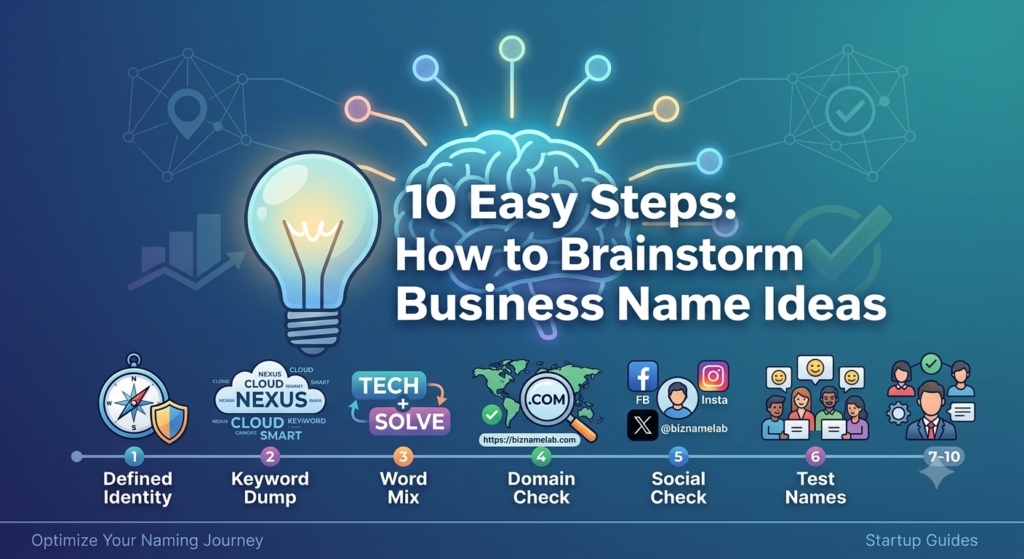
For a deeper dive into the ideation phase, check out this guide on how to brainstorm business name ideas — it pairs well with everything covered here.
Step-by-Step Blueprint to Feed Data into an AI Naming Engine
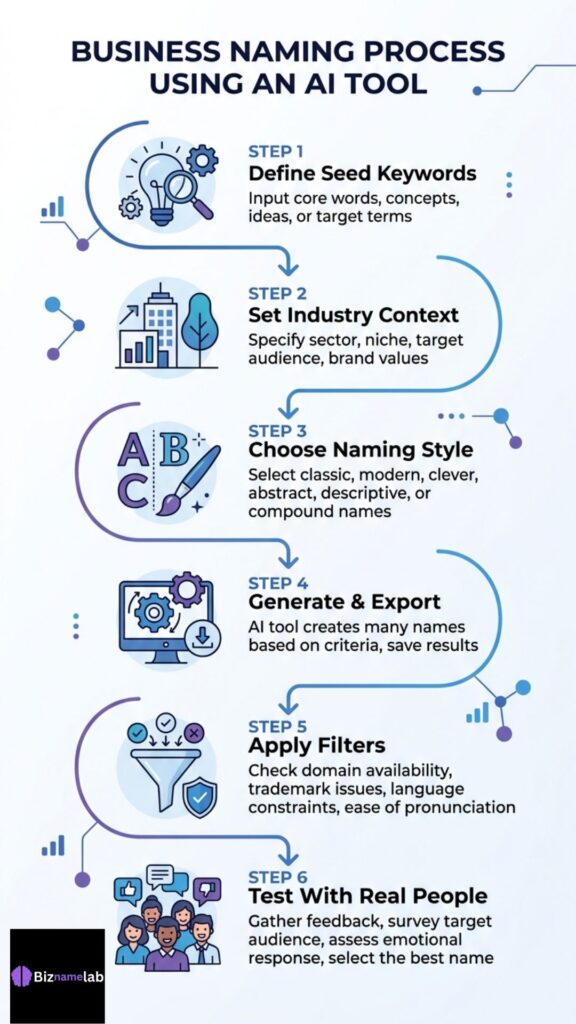
The quality of output from any AI business name generator is directly tied to the quality of input you give it. Here’s a practical step-by-step process:
Step 1: Define Your Seed Keywords
Choose 3 to 5 words that represent your brand’s core. These are your seed keywords input. Avoid generic terms like “best” or “pro.” Instead, use emotionally or functionally specific words: “velocity,” “roots,” “clarity,” “mesh,” “nova.”
Step 2: Set Your Industry Context
Most advanced tools let you select your industry category — whether that’s tech startup names, wellness, finance, retail, or logistics. This activates industry-specific naming algorithms that weight output toward vocabulary your target customers actually recognize and trust.
Step 3: Choose a Naming Style
Select the tone and structure you want. Do you want a made-up word (coined term), a compound word, an acronym, or a real word used metaphorically? This shapes the entire output pool.
Step 4: Generate and Export
Run the generator and export your full results. Don’t pre-filter in your head during this phase. Volume is the goal at this stage.
Step 5: Apply Filters
Narrow your list using the filtering criteria covered later in this guide — length, pronounceability, domain availability, and trademark status.
Step 6: Test With Real People
Take your top 5 to 10 names and run informal tests: say them aloud, spell them in a text, and share them with 3 to 5 people in your target demographic. Real-world feedback at this stage is irreplaceable.
The Core Cognitive Benefits of Algorithmic Brainstorming Over Manual Lists
There’s a reason professional naming agencies are increasingly using AI tools internally, even when they don’t advertise it. Automated brainstorming engines remove several well-documented cognitive biases that cripple manual naming sessions.
Availability bias — Humans tend to recall and reuse familiar words. An AI draws from a far wider vocabulary base, surfacing combinations that would never cross a founder’s mind.
Anchoring — Once you write down your first three name ideas, every subsequent idea gets unconsciously compared to those three. AI generates options in parallel, without this anchor effect.
Confirmation bias — You’re more likely to love names that confirm your existing vision. Algorithmic output challenges that by presenting linguistically diverse options across styles and tones.
To generate unique business names instantly, you need a tool that operates outside your existing mental models. That’s exactly what a well-trained naming engine does. It doesn’t get tired, doesn’t fall in love with its own ideas, and doesn’t have ego invested in any particular result.
Different Linguistic Styles You Can Unlock with Advanced Automation
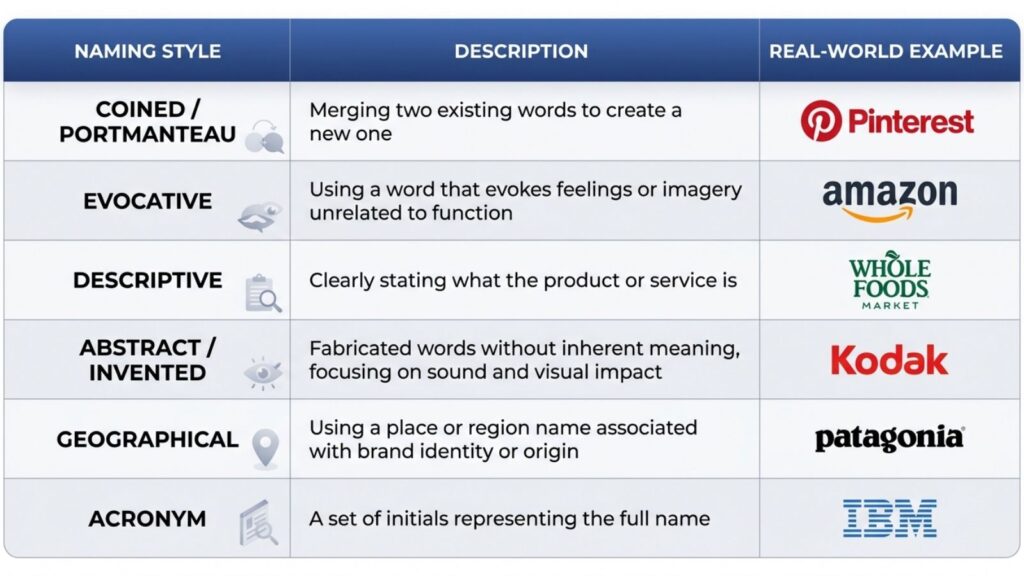
One of the most underused features of any advanced AI business name generator is its ability to produce names in distinct linguistic styles for startups. These aren’t just aesthetic choices — they shape how customers perceive and remember your brand.
| Style | Description | Example |
|---|---|---|
| Coined/Portmanteau | Blends two real words into one new word | Pinterest (pin + interest) |
| Evocative | Real word used metaphorically | Amazon, Apple, Shell |
| Descriptive | Directly states what the brand does | Whole Foods, General Motors |
| Abstract/Invented | Entirely made-up word with no prior meaning | Kodak, Xerox |
| Geographical | Named after a place for authenticity | Patagonia, Fuji |
| Acronym | Initials of a longer name | IBM, BMW |
Most founders default to descriptive naming because it feels “safe.” But research in brand recall consistently shows that abstract and evocative names outperform descriptive ones once a brand achieves any meaningful scale. Your AI tool can generate all of these styles on demand — use that capability intentionally.
For more guidance on balancing memorability and professionalism in naming, this resource on how to choose a business name that sounds both catchy and professional covers the decision framework in detail.
Critical Filters to Apply When Sorting Automated Naming Output
Getting 200 name suggestions is only useful if you have a clear framework for cutting them down. Apply these filters in sequence:
Filter 1: Pronounceability
Say the name out loud three times. If you stumble even once, a potential customer will too. Eliminate names that require explanation.
Filter 2: Spelling Clarity
If someone hears the name spoken, can they spell it correctly on the first try? Names with silent letters, unusual phoneme combinations, or ambiguous vowel sounds create long-term friction.
Filter 3: Length and Rhythm
One to three syllables is the sweet spot for catchy business names. Longer names can work, but only if they have strong rhythmic flow (like “Instagram” or “Salesforce”).
Filter 4: Domain and Social Handle Availability
Check both simultaneously. A .com domain and a matching social handle are the modern minimum. Filtering domain extensions like .co, .io, or .ai can expand your options — but be deliberate, not desperate.
Filter 5: Cultural and Linguistic Red Flags
If you’re targeting any non-English-speaking market, run your shortlist through a basic translation check. Some perfectly innocent English words carry negative or absurd meanings in other languages.
Filter 6: Trademark Conflict Potential
Before you get emotionally invested in any name, run a preliminary keyword check for existing trademarks. This isn’t the full legal check — that comes next — but it’s a quick first screen.
Moving Beyond Ideation: Verifying Real-World Domain Availability
A brilliant brand name means nothing if the digital real estate is already claimed. Verifying digital asset availability is not an optional step — it’s a hard gate in the process.
Checking your domain: Use ICANN’s official WHOIS lookup tool at lookup.icann.org to verify current domain registration status. This is authoritative, free, and shows you not just availability but current registrant data if a domain is taken.
Here’s what to look for during your domain name search:
- Is the exact-match .com available? This is the gold standard.
- If not, is a .co, .io, or .ai version available and industry-appropriate?
- Is the domain parked (owned but unused)? Parked domains can sometimes be purchased directly from the owner.
- Are there common misspellings of your name that competitors could exploit?
Don’t skip checking social media handles at the same time. Twitter/X, Instagram, LinkedIn, and TikTok handles should match your domain as closely as possible. Inconsistent handles create lasting brand confusion.
Protecting Your Digital Assets: Running an Official Trademark Check
This step is where many founders cut corners — and pay for it later. Legal brand protection starts with a proper trademark search before you commit any resources to a name.
The United States Patent and Trademark Office provides a free, public search tool called TESS (Trademark Electronic Search System), accessible at tmsearch.uspto.gov. It’s not the most intuitive interface, but it’s authoritative.
How to Run a Basic Trademark Search
- Go to the USPTO search portal.
- Search your candidate name as a basic word mark search.
- Look for exact matches AND phonetically similar marks in your target industry class.
- Pay attention to the goods/services class — a trademark on “Apex” in the food industry doesn’t automatically block you from using “Apex” in software.
- Review both live and dead marks — a dead mark can still create confusion risk.
Important: A USPTO search is not a substitute for legal advice. Once you’re serious about a name, engage a trademark attorney for a formal clearance opinion. The cost is modest compared to a cease-and-desist letter after launch.
Trademark availability check isn’t just about legality — it’s about brand defense. Owning a registered trademark gives you significantly stronger protection against copycats and domain squatters than an unregistered brand name.
Frequently Asked Questions (FAQ) About AI Naming Algorithms
What makes an AI business name generator different from a random name picker?
A random name picker has no linguistic intelligence — it just concatenates words. A proper AI business name generator uses trained models that understand phonetics, brand psychology, industry vocabulary, and memorability patterns. The output is meaningfully different in quality.
Can I trademark a name generated by an AI tool?
Yes — as long as the name meets standard trademark requirements (distinctiveness, no existing conflicts, not purely descriptive). The origin of the name doesn’t affect its trademarkability. What matters is whether it’s available and unique enough to qualify for protection.
Is a free company name generator as good as a paid tool?
Free company name generators vary widely in quality. Some offer genuine value as starting-point idea engines. Paid platforms typically offer deeper filtering, real-time domain checks, trademark pre-screening, and more linguistic style options. For a serious brand launch, a paid or premium tool is worth the marginal cost.
How many name options should I generate before shortlisting?
Aim for at least 50 to 100 raw candidates before you start eliminating. The first 10 names any AI returns are often the most generic — volume gives you access to the more unexpected, distinctive options deeper in the output.
Does AI naming work for all industries?
Yes, but quality varies by how specific your seed inputs are. The more precise and emotionally specific your seed keywords, the better the industry-specific naming algorithms will perform. Vague inputs return generic output regardless of the tool’s sophistication.
What if my perfect name is already taken as a domain?
You have three options: purchase the domain from the current owner (check WHOIS data at lookup.icann.org for contact info), use an alternate extension (.co, .io, .ai), or modify the name slightly with a prefix or suffix. Modifying the name is often the cleanest long-term solution.
Ready to Launch Your Next-Gen Identity? Test Our Engine Today!
You’ve done the research. You understand how AI business name generators work, what inputs produce the best output, and how to filter down to a name worth building a brand around. Now it’s time to move from knowledge to action.
Head to BizNameLab and run your first generation session using the framework in this guide. Bring your seed keywords, define your industry, and set your naming style — then let the engine do what it does best: surface options your brain simply wouldn’t reach on its own.
The perfect brand name is closer than you think. Start there, filter smart, verify everything, and protect what you build.
Key Takeaways
- An AI business name generator uses NLP and machine learning to produce brand names tailored to your industry, tone, and keywords — far faster than manual brainstorming.
- Most naming failures happen because of cognitive biases (anchoring, availability bias) that AI tools naturally bypass.
- The best results come from clear, specific seed keywords input — not vague descriptors.
- Always verify domain availability via ICANN WHOIS and trademark status via USPTO TESS before committing to any name.
- Apply structured filters — pronounceability, spelling clarity, length, cultural fit — before you finalize your shortlist.
- Legal brand protection through trademark registration is a business asset, not just a formality.
- A .com domain remains the gold standard, but .co, .io, and .ai extensions are increasingly accepted in tech and startup verticals.
Conclusion
Naming a brand is one of the highest-stakes decisions an early-stage founder makes — and it’s one of the few that doesn’t need to be a guessing game anymore. An AI business name generator gives you the breadth of a professional naming agency and the speed of automation, without the five-figure invoice. Use it as the volume engine it was designed to be, apply rigorous filters on the back end, and never skip the domain and trademark verification steps. The right name is out there. The tools to find it have never been better.